2026 Symposium
 |
 |
Washington University Global Studies Law Review
&
Whitney R. Harris World Law Institute
2026 Symposium
From Promise to Precarity:
Rethinking International Law After a Quarter-Century
February 6, 2026 | Washington University in St. Louis, School of Law
At the turn of the 21st century, international lawyers may have imagined a future of increased coalescence
around shared values, more effective rule-based problem solving, and international organizations serving as
orchestrators and facilitators of an increasingly open and democratic world society. That imagined future has
not materialized. Instead, we see a landscape marked by fragmentation, contestation, and new centers of
power.
Private actors, corporations, and algorithms now shape transnational governance in ways that outpace
traditional legal regulation, challenging us to rethink authority and responsibility in the digital age.
International economic law struggles to adapt as the World Trade Organization falters and states turn inward,
forcing difficult choices about how trade rules can be reshaped to meet the demands of a fractured, multipolar
economy. International criminal justice faces crises of legitimacy and uneven enforcement, raising questions
about the future of accountability.
The 2026 Symposium asks how international law should respond in this moment of disruption. Are we
witnessing the erosion of the legal order painstakingly built over the last century, or the emergence of new
forms of legitimacy and cooperation? What lessons can be drawn from the past quarter-century, and how might
they help us imagine a more responsive, resilient, and just international law for the decades ahead?
This reflection is especially timely for Washington University School of Law, which in 2025 is celebrating the
25th anniversaries of both the Washington University Global Studies Law Review and the Whitney R. Harris
World Law Institute. Over the past twenty-five years, these institutions have fostered scholarship and
dialogue on the most pressing issues in international law. Looking ahead, WashU Law seeks to carry this
legacy forward by convening critical debates and helping shape the agenda for international law’s next quarter
century.
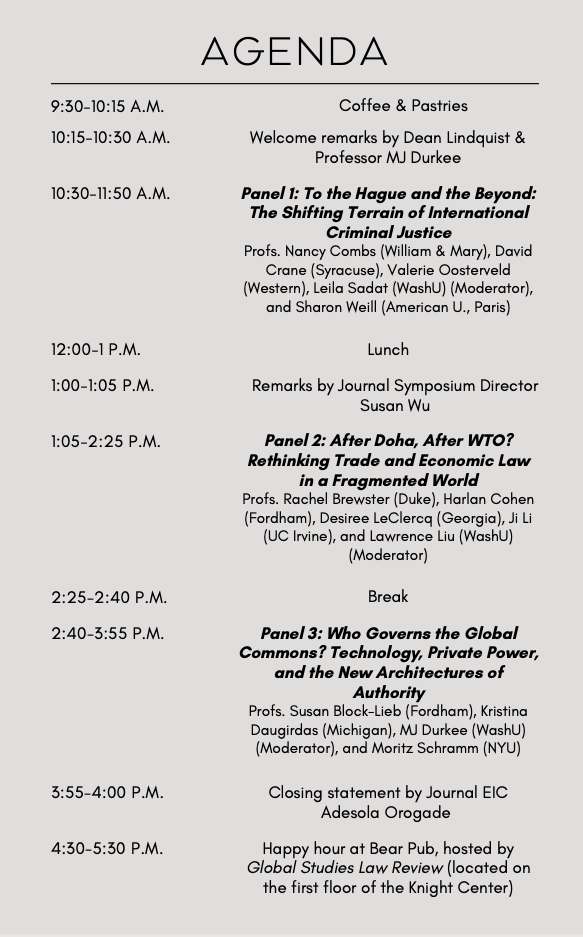
Panel 1: To the Hague and Beyond: The Shifting Terrain of International Criminal Justice
International and national criminal courts and tribunals have, over the past thirty years, offered some
accountability for perpetrators of international crimes. Mechanisms have included ad hoc tribunals created by
the Security Council and by treaties with States, the International Criminal Court (ICC), and national
prosecutions taking place as a matter of transitional justice or as universal jurisdiction prosecutions. More
recently, with the creation of the Special Tribunal for the Crime of Aggression by the Council of Europe,
regional alternatives appear to be emerging. Yet mass atrocities continue to occur in every region of the world,
and this panel asks what can be done to ensure that accountability and justice can become more effective in the
future. What have hybrid tribunals, ad hoc courts, and domestic prosecutions taught us about
legitimacy andeffectiveness? How should international criminal justice adapt in an era of geopolitical
contestation, declining multilateralism, and ongoing atrocities in real time?
Panel 2: After Doha, After WTO? Rethinking Trade and Economic Law in a Fragmented World
Global economic law once centered on the World Trade Organization’s promise of multilateralism. Today, that
system falters: the Appellate Body remains paralyzed, regional trade agreements proliferate, and economic
nationalism resurges. Meanwhile, new issues, such as climate trade measures, digital commerce, and supply
chain resilience, demand urgent legal responses. This panel revisits international economic law’s evolution
since 2000 and looks forward. Should the WTO be reformed or bypassed? How can trade law reconcile free
exchange with security, sustainability, and sovereignty?
Panel 3: Who Governs the Global Commons? Technology, Private Power, and the New Architectures of
Authority
The last quarter-century has seen the rise of non-state actors as de facto governors of global order—private
tech firms regulating speech and data across borders; AI systems reshaping decision-making from commerce
to security; and public-private partnerships managing everything from space exploration to pandemic
preparedness. Traditional treaty law and state-centered institutions struggle to keep pace. This panel explores
how privatization, digitization, and AI are reconfiguring governance. Are corporations and algorithms the new
“sovereigns”? What frameworks—legal, ethical, or hybrid—could ensure accountability, equity, and
transparency in this emerging order?
* * *
The Symposium is meant to grapple with questions that cut across disciplines and institutions. Rather than
offering tidy answers, it seeks to spark debate, reimagine trajectories, and push boundaries. Contributions will
appear in a dedicated Global Studies Law Review Symposium Issue. In marking the 25th anniversaries of the
Whitney R. Harris World Law Institute and the Global Studies Law Review, the event also underscores WashU
Law’s commitment to shaping the conversations that will define international law’s next quarter century.
Expected Panelists
Panel 1: To the Hague and Beyond: The Shifting Terrain of International Criminal Justice
- Nancy Combs, Ernest W. Goodrich Professor of Law at the William & Mary Law School.
- Sharon Weill, Associate Professor of International Law at the American University of Paris.
- David Crane, Distinguished Scholar in Residence at the Syracuse University College of Law.
- Valerie Oosterveld, Professor and Research Chair in International Criminal Justice at the Western University Faculty of Law.
Moderated by Professor Leila N. Sadat
Panel 2: After Doha, After WTO? Rethinking Trade and Economic Law in a Fragmented World
- Ji Li, Professor of Law and John S. & Marilyn Long Chair of US-China Business and Law at the University of California, Irvine School of Law.
- Rachel Brewster, Jeffrey and Bettysue Hughes Distinguished Professor of Law at the Duke University School of Law.
- Desiree LeClercq, Assistant Professor of Law & Faculty Co-Director of the Dean Rusk International Law Center at the University of Georgia School of Law.
- Harlan Cohen, Professor of Law at the Fordham University School of Law.
Moderated by Professor Lawrence J. Liu
Panel 3: Who Governs the Global Commons? Technology, Private Power, and the New Architectures of Authority
- Moritz Schramm, Assistant Professor at the New York University School of Law.
- Kristina Daugirdas, Francis A. Allen Collegiate Professor of Law at the University of Michigan Law School.
- Susan Block-Lieb, Professor of Law; Cooper Family Chair in Urban Legal Issues at the Fordham University School of Law.
Moderated by Professor Melissa J. Durkee